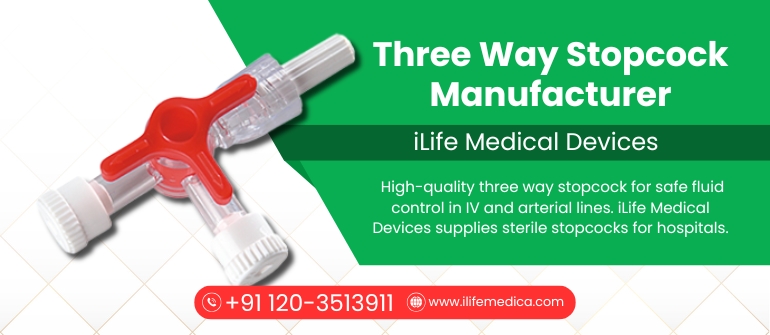
A three way stopcock is an essential medical device used to control, direct, and regulate the flow of fluids in intravenous and arterial lines. It allows healthcare professionals to manage multiple fluid pathways simultaneously without disconnecting the line, which significantly improves safety and efficiency during clinical procedures.
At iLife Medical Devices, we manufacture high-quality three way stopcocks designed for reliable performance in hospitals, ICUs, operation theaters, and emergency care settings.
What Is a Three Way Stopcock?
A three way stopcock is a small, sterile device with three ports and a rotating handle that controls fluid direction. It enables the connection of multiple IV lines, syringes, or monitoring devices to a single access point.
The device typically consists of:
- Three luer-compatible ports
- A smooth rotating tap or handle
- Transparent body for flow visibility
- Secure, leak-proof connections
Its simple yet precise design makes it indispensable in modern infusion and monitoring systems.
Importance of Three Way Stopcock in Clinical Practice
In critical care environments, managing fluid flow accurately is crucial. A three way stopcock allows clinicians to administer medications, flush lines, and monitor pressure without interrupting ongoing therapy.
A reliable three way stopcock helps:
- Reduce the risk of infection by minimizing line disconnections
- Improve workflow efficiency
- Maintain continuous infusion
- Enable accurate pressure monitoring
- Enhance patient safety in critical procedures
Key Features of iLife Medical Devices Three Way Stopcock
Medical-Grade, Transparent Construction
Manufactured using high-quality, medical-grade materials that ensure durability, biocompatibility, and clear visibility of fluid flow.
Smooth & Precise Flow Control
The rotating handle allows accurate control of fluid direction, helping clinicians manage multiple lines with confidence.
Leak-Proof Luer Lock Connections
Secure luer connections prevent leakage and accidental disconnections during infusion or monitoring.
High Pressure Resistance
Designed to withstand pressure variations, making it suitable for both IV therapy and arterial line applications.
Sterile & Single-Use Design
EO-sterilized and individually packed to maintain sterility and reduce the risk of cross-contamination.
Applications of Three Way Stopcock
A three way stopcock is widely used across multiple medical departments, including:
- Intensive Care Units (ICU)
- Emergency and trauma care
- Anesthesia and operation theaters
- Arterial pressure monitoring
- IV infusion and medication administration
It is commonly used alongside infusion sets, IV cannulas, and arterial line cannulas in various clinical procedures.
In intravenous therapy, a three way stopcock is commonly connected to an IV set to manage multiple fluid lines efficiently.
During invasive blood pressure monitoring, a three way stopcock is frequently used with an arterial line cannula in critical care settings.
Three Way Stopcock in IV & Arterial Line Systems
Three way stopcocks play a vital role in both IV therapy and arterial monitoring systems.
- In IV therapy, they help manage multiple infusions and medication administration through a single access point.
- In arterial lines, they assist in pressure monitoring and blood sampling without disconnecting the system.
This versatility makes them a critical component in advanced patient care.
Why Choose iLife Medical Devices for Three Way Stopcocks?
At iLife Medical Devices, quality and reliability are central to our manufacturing philosophy.
Our Strengths Include:
- Strict quality control and testing
- Compliance with international medical standards
- Consistent performance in critical care environments
- Suitable for hospital, institutional, and bulk supply requirements
Our three way stopcocks are designed to meet the demanding needs of modern healthcare professionals.
Quality Assurance & Safety Standards
Each three way stopcock undergoes rigorous inspection to ensure:
- Sterility assurance
- Leak-proof performance
- Smooth flow control
- Material safety and durability
This ensures dependable use in both routine and critical medical procedures.
Conclusion
A high-quality three way stopcock is essential for precise fluid control and safe patient management in modern healthcare. With a strong focus on quality, safety, and performance, iLife Medical Devices offers three way stopcocks that healthcare professionals can rely on in both routine and critical care settings.
FAQs – Three Way Stopcock
1. What is a three way stopcock used for?
A three way stopcock is used to control and direct the flow of fluids between multiple IV or arterial lines. It allows healthcare professionals to administer medications, flush lines, or monitor pressure without disconnecting the system. This helps improve efficiency and patient safety.
2. How does a three way stopcock work?
A three way stopcock works by rotating its handle to open or close specific ports. This rotation determines the direction of fluid flow between connected lines or devices. The design allows precise control with minimal effort during clinical procedures.
3. Is a three way stopcock suitable for arterial lines?
Yes, three way stopcocks are commonly used in arterial line systems for pressure monitoring and blood sampling. Their pressure-resistant and leak-proof design makes them suitable for critical care applications. Proper usage ensures accurate readings and patient safety.
4. Are three way stopcocks single-use devices?
Yes, three way stopcocks are intended for single use only. Single-use design helps prevent infection, contamination, and cross-patient transmission. This aligns with global healthcare safety standards.
5. Are iLife Medical Devices three way stopcocks sterile?
All three way stopcocks from iLife Medical Devices are EO-sterilized and individually packed. This ensures sterility is maintained until the time of use. Proper packaging supports safe handling in clinical environments.
6. Can a three way stopcock be used with IV sets and infusion sets?
Yes, three way stopcocks are compatible with standard IV sets and infusion sets. This compatibility allows flexible integration into IV therapy systems, improving workflow efficiency and treatment accuracy.
